
Amazon Will Dominate Physical AI
Why the Physical AI Revolution Will Be Won by the Company That Already Moves the World’s Atoms

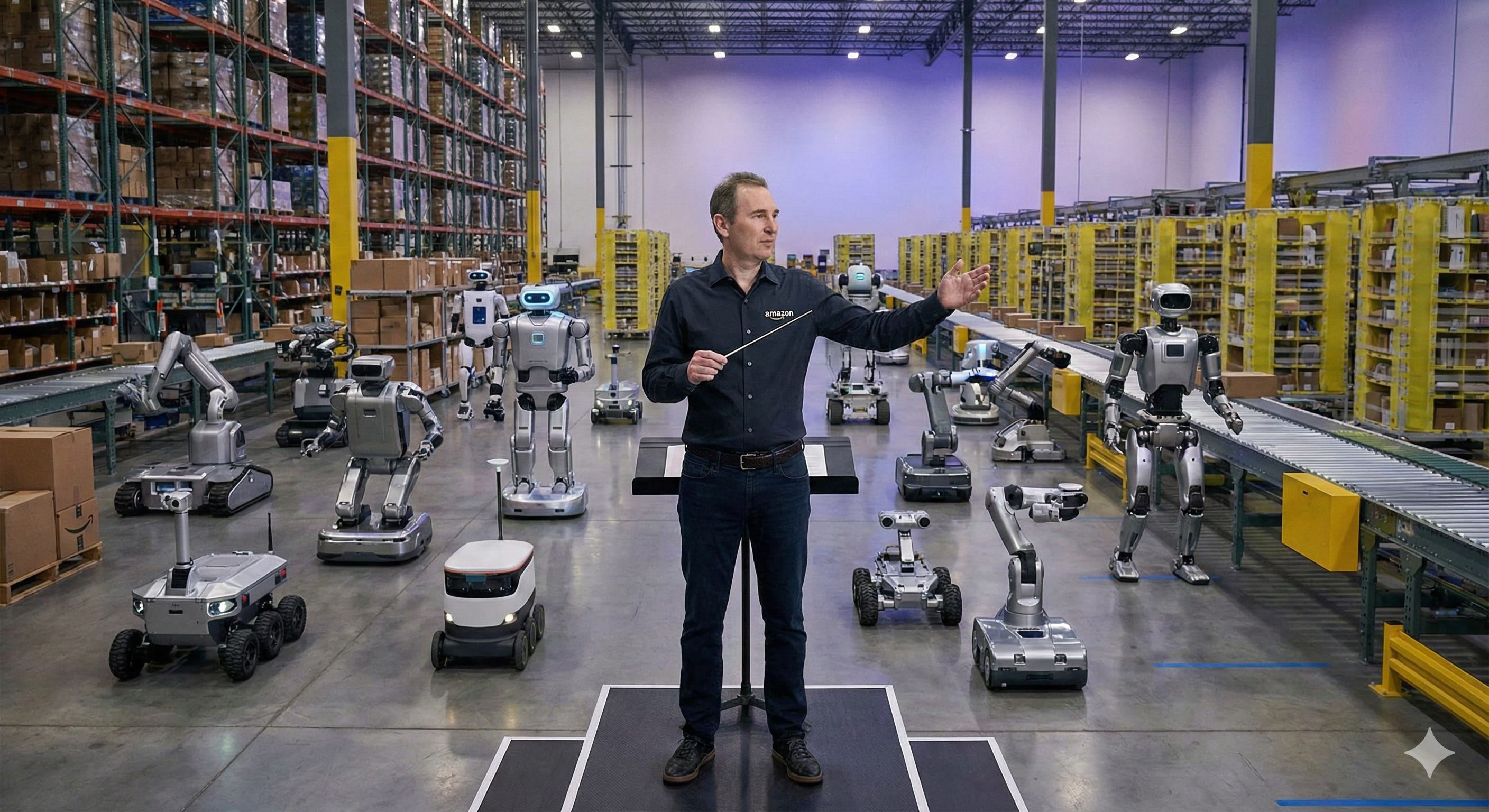
Physical AI, meaning AI systems that can perceive, decide, and act in the real world, is the next platform shift. It is not just about smarter chatbots. It is about turning intelligence into motion, and motion into money.
A lot of the public conversation is still stuck on humanoid theatrics and futuristic demos. Meanwhile, the winners are quietly being selected by a much less glamorous question: who already has a giant physical operation where you can deploy, measure, and iterate on robotic intelligence every single day. By that standard, Amazon is in a category of its own.
Physical AI rewards deployed infrastructure, not hype
The uncomfortable truth about physical AI is that the model is only a fraction of the product. The hard part is everything around it: sensors, safety constraints, uptime, workflow integration, exception handling, maintenance, training, and the thousand tiny edge cases that never appear in a staged demo.
That is why even optimistic observers acknowledge that general-purpose humanoids are still difficult to deploy broadly, and why many near-term efforts focus on task-specific robots and real workplace integration instead of sci-fi generality.
The result is a simple investing lens: when the big “breakthrough” arrives, the biggest upside will not necessarily go to whoever trained the flashiest model. It will go to whoever can put that model to work at scale, quickly, safely, and repeatedly, in environments that generate measurable ROI.
Amazon is already running the largest real-world robotics lab in the US
Amazon is not preparing for a robotics future. It is already living in it. The company says it has deployed its one millionth robot, and that its robotics network spans more than 300 facilities worldwide.
That matters because physical AI is fundamentally about reps. If you have a million machines doing real work, you can run more experiments in a week than most competitors can run in a year.
Amazon’s robotics efforts are not limited to one robot type. The fleet spans autonomous mobile robots and multiple robotic arms and systems designed specifically for fulfillment and sorting workflows.
And Amazon is not just “buying robots.” It is making operational AI part of the machinery. Amazon has introduced DeepFleet, which it describes as a generative AI foundation model designed to coordinate robot movement across its fulfillment network, targeting a 10% improvement in robot travel efficiency.
Amazon already paid the tuition for scaling robots inside messy operations
Amazon’s robotics advantage did not appear overnight. The company’s modern warehouse robotics era traces back to its acquisition of Kiva Systems in 2012, a foundational move that let Amazon rebuild fulfillment around robots instead of simply “adding automation” as an afterthought.
From there, Amazon built the muscle that most companies underestimate: integrating automation into end-to-end workflows.
Next-generation systems like Sequoia are a good example. Amazon says Sequoia can identify and store inventory up to 75% faster and reduce order processing time through a fulfillment center by up to 25%, while redesigning ergonomics for human workers at the same time.
This is also where you see the gap between Amazon and everyone else. Warehouse automation is brutally hard and expensive, and not every major retailer has found the formula. Some high-profile automated fulfillment initiatives in the broader retail world have been scaled back, which underscores that “robotic fulfillment” is not a plug-and-play win even at scale.
Edge inference is the switch, and Amazon owns the edge stack
The core point is simple: physical AI gets radically more valuable when inference is reliable at the edge. The robot cannot wait for a round trip to the cloud to avoid a collision, regrip an object, or recover from a near-failure. Low latency and high uptime are the difference between a cute prototype and a production worker.
Amazon is uniquely positioned here because the company already sells and operates the tooling to deploy ML inference to fleets of edge devices. AWS tooling supports running ML inference on edge devices using cloud-trained models, and it is designed around the idea of low-latency local inference with centralized training and deployment workflows.
On top of that, Amazon has an existing enterprise-grade stack for fleet management and model deployment. AWS services simplify deploying models and agents across fleets of edge devices.
So when a model maker, whether internal or external, delivers a true step change in robot capability, Amazon’s implementation pathway is short. The company does not need to invent distribution. It already has distribution, inside its own operations.
The deployment and iteration loop will compound faster at Amazon than anywhere else
The biggest misconception about physical AI is that the breakthrough moment is the finish line. In reality, the breakthrough is the starting gun for an iteration race.
Amazon is built to win that race because its robots are already embedded in the work. The loop looks like this:
Deploy a capability to a subset of facilities.
Measure cycle time, error rates, safety incidents, and throughput in production.
Identify edge cases that matter economically.
Update the model, the workflow, or both.
Redeploy and repeat, across more sites, with better data each turn.
Amazon is already showing pieces of this loop in public. It is explicitly positioning DeepFleet as a learning system that improves over time using Amazon’s operational datasets, and it is tying that improvement to concrete operational outcomes like faster delivery and lower cost.
This is what competitors cannot quickly replicate. You can build a robot. You cannot quickly build a planet-scale fulfillment environment where robots generate continuous feedback signals, and where every incremental improvement immediately pays for the next one.
The data flywheel gets supercharged as robots gain touch and dexterity
Physical AI gets dramatically better when robots gather richer data: tactile feedback, force signals, perception in clutter, and failure recovery attempts. Amazon is clearly pushing in that direction.
Amazon’s Vulcan robot, described as having a “sense of touch,” is part of this trajectory. Amazon has already begun running Vulcan in real fulfillment centers, with additional deployments planned.
This matters for the flywheel because tactile manipulation is one of the most stubborn barriers in robotics. If Amazon can collect real tactile and manipulation data at scale, it can feed future training runs, improve policies, and then roll those improvements back into the fleet. That is compounding advantage in its purest form: more robots create more data, more data creates better models, better models create more productive robots.
Tesla is building a humanoid. Amazon is building a robot economy
Tesla deserves credit for ambition. The company frames Optimus as a goal to build a general-purpose bipedal humanoid robot.
But this is exactly the point: Tesla is still largely in the phase of proving what a humanoid could do, and then building manufacturing capacity and supply chains around it. Even in Tesla’s own framing, the project is an end-goal program that depends on building multiple software stacks for real-world interaction.
Amazon’s advantage is different and, in my view, far more investable. Amazon is not waiting to invent a new robot category to justify deployment. It already has deployed robots in the environments where physical AI will pay first: repetitive, high-volume logistics workflows. When the breakthrough physical AI model shows up, Amazon’s robots do not need a new market. They need a software upgrade.
The payoff is massive cost leverage, faster delivery, and a second compounding engine
Amazon has been unusually direct about the operational upside of its next-generation fulfillment design. In next-generation facilities, the company has described multi-floor operations where automation can hold tens of millions of items and coordinates thousands of mobile robots plus multiple robotic arms.
Zoom out and you can see why this becomes a long-duration bull case. Amazon is not simply automating. It is building an operating system for the movement of atoms: pick, stow, sort, pack, route, deliver.
If you believe physical AI is coming, then Amazon is not just exposed to the trend. It is positioned to turn physical AI into a reinforcing advantage that rivals will struggle to match, because the advantage is not a single model or a single robot. It is the scale of the loop.
Closing: In physical AI, the winner is the one with the most reps
The story most people tell about robotics is hardware-first: build a humanoid, then find jobs for it. Amazon’s story is ops-first: deploy robots into the world’s most demanding logistics machine, then use software and data to make them smarter every quarter.
That is why Amazon is the only US player truly prepared for the physical AI revolution, if “prepared” means something specific: already operating the robot fleet, the facilities, the edge infrastructure, and the iteration cadence required to capitalize on a breakthrough the moment it lands.
Disclosure: This is not investment advice.
You make a solid case. Amazon has such a head start in the size of their operation, it will be nearly impossible for any other company to match the opportunity to put physical AI to work. And Amazon has taken the initiative to already be putting physical AI in the distribution loop. Nicely written and thought out.
and you can't imagine the size, scale and time they have to access enormous volumes of data with which train models especially dormain ones